Dean’s Mexico Hour Record Attempt
I aged up to 50 this year, and taking another shot at the age group hour record at the fastest track around was the perfect season goal. I enjoyed riding and training all year, but keep this in the background as the key event I wanted to feel my best at. I was fortunate to join a trip to the fast Aguascalientes Mexico velodrome organized by Peter and Maria Megdal where 10 of us would make record attempts. Aguascalientes is a special track since it’s 6200 feet above sea level where the air is thin and fast, so many records are set here. You can read about my 2024 record attempt in Ontario Canada here.
Why is this track so fast? The air density is about 20% less up there, so you’ll face much less aerodynamic drag. This is a big deal making up 90% of what you have to overcome at record speed (the other 10% being rolling and drivetrain resistance). On the other hand, you’ll lose about 12% power compared to sea level if you’re not acclimated. I struggle with power loss at altitude and expect up to a 15% loss based on how I’ve responded in the past. While these numbers still look heavily in your favor, we then need to adjust CdA for altitude which is an often overlooked step. That CdA (Aerodynamic Drag coefficient) you’ve heard so much about lately actually goes up about 4% at this altitude because of the air density reduction. Your power loss and CdA increase offsets most of that air density reduction, but not all of it. We still end up about 1% ahead so for me that’s about 500 meters farther than at sea level. You can push this advantage even more by acclimating at altitude for 3 weeks like the professionals do, but that was not part of this trip.
The age 50-54 UCI Hour Record is 51.013km set on this same track by the USA’s Patrick Warner. I first met Pat 10 years ago when he invited me to fill-in on his team pursuit squad at my first track nationals. This also involved teaching me how to team pursuit in one day. We won that day and I was hooked. We’re in different age groups, but see him and catch up at big races. I watched Pat win 4 world titles at Masters Track Worlds one year. He’s so strong in every event, but the only events I can compete with him are flat like the Hour. He also set the new 55-59 record last year, so he won’t miss this one right?
My plan was to hold 51.0km/hr pace the first 30 minutes, then ramp up the second half if I felt good. All my position work and training showed this would be possible on this track, but that’s only the beginning. I spent another year aero testing equipment and positions allowing me to hold this required pace in the most sustainable, and fastest position I could. We aren’t allowed computers or power meters, so my only feedback during the attempt are lap times which serve as your pacing tool as you ride. My target for a 51.0km finish was 17.5 second lap splits so the moment I heard a 17.4, I would make sure the next lap was 17.6 so I was back to even. I repeated the phrase in my head “keep it boring”. I didn’t want to spend a watt more than necessary to get through this first half. If I stayed here, my effort should stay under control and I wouldn’t overheat and blow up like I did last time.
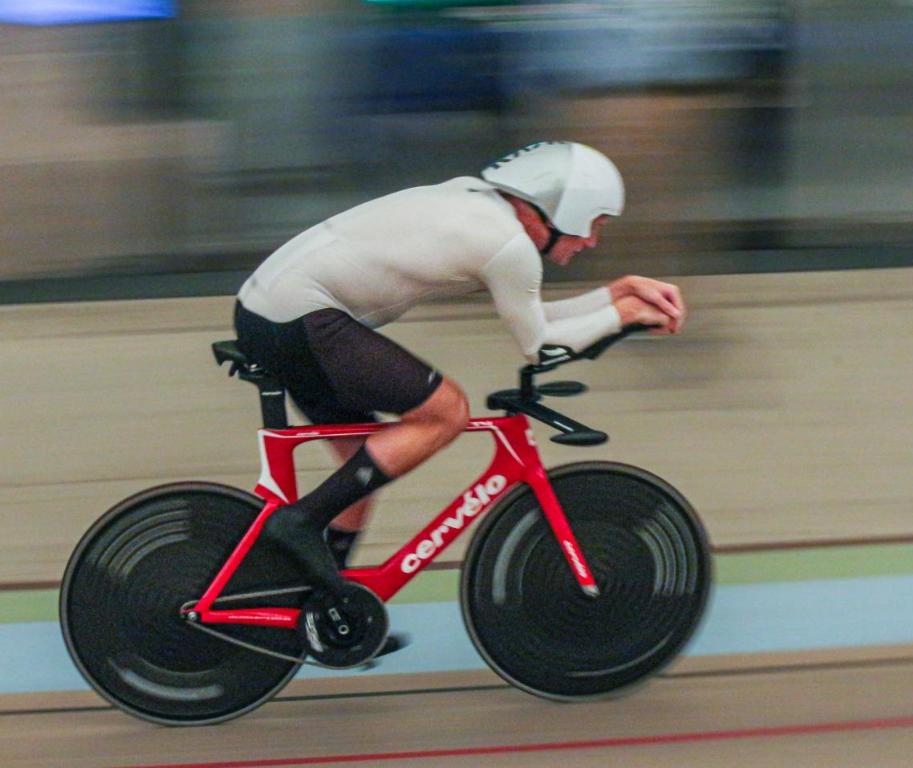
I found the first 5 minutes harder than I expected and they seemed to take longer than last time. I think this was mainly because the track was cool so it took slightly more power to go the same speed. I also shortened my warmup to the bare essential time of about 15 minutes to keep core temperature down. I was open enough to start, but warming up into it. I still felt OK and continued to the 10 minute mark where running through my body everything still checked out: steady breathing, no burn, cool feeling of wind on my face and body, shoulders and hands were relaxed. Keep it boring, it’s just a training day. A mantra I’d said so much this morning that right when the nerve wracking digital countdown finished Peter and Maria yelled “It’s just a training day” as I smiled and left the gate. I wobbled a bit coming out of the gate as I’d never started with a 58×12 gear, but got it going fine.
I started with a track temperature of 65 degrees. If you read about Hour attempts, that will sound cold. Most are set on 75-85deg tracks. On one hand the cooler track allows me to ride at my top power without overheating (like I did in my last hour attempt, burned in my recent memory) but on the other hand the hot track has lower air density and lower rolling resistance so requires less power to go that same speed. This track also warms up about 5 degrees per hour as the morning sun cooks the roof of the dome so that needs to be planned for too. What is the Goldilocks temperature where it’s cool enough to not overheat, but warm enough to take advantage of the lower resistance? I spent more time thinking about this part than anything else as my testing shows it takes 3-4 watts less effort for every 5 degree temperature change on this track. The exact relationship is too dependent on small details. Every sentence I write I feel I could go on hour long rabbit holes, so I’ll leave it at that my wish for this attempt was for a 65-69deg starting temperature. I felt even at 65 degrees I could hold the pace and would rather take less risk of overheating late even if it meant leaving 100+ meters on the table.
Things were still “boring enough” at the 15 minute mark. I was working hard, but actually felt more warmed up, in a better rhythm, and riding a smooth line. I’ve ridden 50 laps now, so lots of practice getting the smoothest line entering and exiting each turn. I loved that this thing was happening and all the waiting and preparation this past year were over. Reaching the 20 minute mark would be a big landmark as that’s when I started overheating last time. Peter Megdal was giving me time splits and key information. I’ve known Peter for decades on the local time trial scene, and yesterday watched him set the new 65-69 hour record. Planning this trip involved he and his wife Maria organizing every detail from renting the track, to bringing in all the UCI officials, doping control, endless paperwork, and all the local authorities from shuttle drivers to required medical staff. Watching and cheering Peter on during his successful record yesterday I found was a great way to go through race day rehearsal in setup and execution. He’s done 10 of these hour record attempts so he seems so relaxed and I found that helped too. Peter owned the 60-64 hour record already from a few years ago so would own both records today after setting the new one. USA’s John Mansell would then beat 60-64 hour record the next day on an amazing ride. A great weekend for both of them and testament to how close our track racing community is to helping each other.
I reached 20 minutes safely, feeling good. This was a big breakthrough and I was in new territory. At some point after that mark Peter had called out “50.8” meaning my average speed for the start to that moment was 50.8km/hr. The standing start costs you about 200 meters, so to ride 51.0km in an hour you need to ride 51.2km/hr average the rest of the way. My 17.5 second lap splits put me at that speed. While effort was under control, my body was holding up too. You pull about 1.5 G’s on the turns of this track, so that means each turn this 200 lb guys feels 300 lbs of pressure on his saddle, forearms, and back of his neck and that will change comfort levels over time. I felt good and was getting excited.
I wanted to reach that 30 minute mark so badly. I still felt in control, and in fact no different than after the start. This was still sustainable. The splits were coming down by themselves and I was now letting them. While the track was getting slightly warmer, there’s also a reported “straw stirring the bathtub” effect where your own draft starts moving around since the wall and ceiling are close with no HVAC disrupting the moving air. I’m unsure if this last thing is even true, but I was psyched the laps were coming down. I would hear 17.4 quite often and would only back off if I heard 17.3. Peter called out 51.0km/hr at the 30 minute mark with the first sound of enthusiasm in his voice. The race was on and he knew I was right where I wanted to be. I knew in my head that 17.3 splits is 52km/hr, 17.0 splits is 53km/hr and would make those decisions when the time came. There were still 100 laps to go and my whole body was hurting yet in control, so I planned to stay where I was another 10 minutes.
As I approached the 40 minute mark I was making myself enjoy this, because why not. I could practically see the finish, yet it was still about 60 laps out so anything could happen. It hurt, but I was smiling, gently pulling up on aerobars riding the tightest cleanest line I could as laps clicked by. When I pull my power goes up ever so slightly and speed picks up without feeling like I’m pushing harder. Each passing lap was a few more meters I was pushing myself ahead. I heard Peter call out “51.2!” km/hr at the 40min mark. I knew he knew I had more and this wasn’t stopping. I was 200 meters up on the record and was still hearing lots of 17.3 laps splits and told myself “stay right here”. Once again I’d wait another 5 minutes to get closer to the finish. I had a final kick in me, but it was still too early and risky to use it as once you go too hard things unravel fast.
At 43 minutes, I came out of turn 4 for what would be the 146th time, and crashed. My hour was over, and everything related to a successful finish vanished with it. I’ve been asked a number of times how I crashed which I totally understand as I’d ask the same thing. When you come out of a turn too tight or leaning too much there is often that feeling of “woah” as you brush too close to or even hit the bumpers at the bottom of the track. Bumpers on the track are like foot long bean bags that are designed to slow you down and/or deter you from going near them. I’d come close a few times earlier, but nothing uncommon. Even 4 inches too tight can contact the bumpers to give you a reference point. For some reason on this particular turn I came out so tight I was going to hit them. In a blink, I decided I could no longer make the ‘right’ turn back up track while hitting so many of them, so I went left first. I was now left of the bumpers, going 32mph on a fixed gear bike in aerobars on the flat velodrome floor. In hindsight, the very second I found myself in that situation the only way out was veering right and fighting through all the bumpers to possibly make it back onto the track. I’d have to hit and ride through about 5 of them at this speed. This would all be done tight elbowed aerobars on a fixed gear track bike with double disc wheels making it the most impossible bike to handle in that situation. Whether or not this was even legal wasn’t on my mind, I needed to survive this unforeseen disaster. I didn’t react soon enough, so when I did reach perhaps half way down the straight literally as Peter and the UCI judge were jumping out of the way I then tried to steer back on. I came at too steep an angle where the tires wobbling from the bumpers was too much to steer the bike into the turn in time. I don’t know if my foot came unclipped after I started to fall (I think it did) but my body was no longer balanced over the bike and I was over the bars and tumbling up nearly into the top of the track (the high part where team pursuit lead changes are made). This was all in a blink, and seconds before this I was smiling enjoying pushing myself to the limit I’d hoped to push all year. I never even envisioned crashing on the track in this event, despite all the worst case scenarios I’d thought of. After the horrible sound of carbon fiber parts and human hitting the deck I lay on my back with paramedics and anybody remaining on the track running over. It was quiet. Peter got to me first, told me not to move and all the usual questions to make sure I was OK. It was over.
I don’t even know how to finish this write-up, but I think writing it down has helped me process it and recall my season and the first 43 minutes of this event. I came in with the best form I felt I could, on the fastest sustainable setup I could, and executed it was well as I could outside of steering a few inches into the wrong on that corner. My collarbone was broken, and while it wasn’t displaced it ended up displacing itself on the long flights home which was no fun. I just had surgery to pin it.
I think what happened is devastating and uncharted territory for anybody, but in a strange way I’m past the crash sooner than I thought I’d be. Those close to me or there with me knew how I felt immediately after. The emotional setback only lasts so long. I am proud of all the work and training that went in to this event, even though no actual result is there. I’m looking forward to healing and getting back to life and the shop. I want to thank Maria and Peter Megdal again for organizing such a great event and then on top of it bringing my bike case all the way back from Mexico since I was no condition to travel with it!