
AiRO Update
We’ve been using AiRO on clients for a few months, so the question I’m often getting is what are we learning and how are we applying it? How does it help the every day cyclist and triathlete? I honestly feel I learn more with every AiRO session, but that’s the same thing I say about every aero testing session I do. The relentless pursuit of cycling aerodynamics is more of a journey than a destination. By the way, we came up with that catchy phrase for a series of aero articles we wrote 10 years ago, long before you started seeing it used by the top aero companies now, but I digress. If you have not read our AiRO overview in November “What is AiRO?” you can link to it here.
Let’s look at some examples of results we found and were able to apply to a range of triathletes and cyclists. In these examples I will use the rough conversion of every 0.001 CdA change equaling 1 watt for typical speeds.
Watts Saved: 15
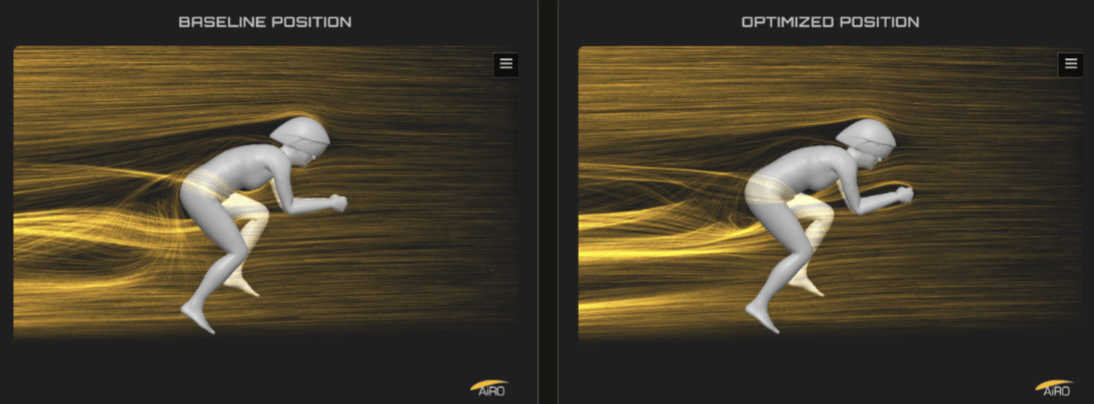
This is an age group Ironman distance triathlete. The photo on the left is before and the right is after. We ran 12 tests of small changes and found two good ones that worked well. We tilted her extensions up 10degrees from where they were and narrowed her elbows about 1.5cm on each side. The position is still just as comfortable and sustainable for her goals. We also tried a range of other adjustments such as more and less extension angle than this, but this is what AiRO tested as the fastest. AiRO measured 15 watts savings which at her power and speed is over 4 minutes of savings in an Ironman bike leg. I especially like to look at the flow simulations and try to discern where the drag savings are showing up. Hers is a little tricky as you see the flow change quite a bit but it’s hard to know which one is faster without AiRO telling us. The darker areas are low pressure zones which are typically behind you. The lighter lines are where flow is generally going or higher pressure zones. You can picture the higher pressure zones as pushing you back, while the lower pressure zones pull you back as a vacuum would.
Watts Saved On Left: 5. Watts Lost On Right: 5

Let’s have a look at how the same change on two different people can have opposite effect. The rider on the left saved 5 watts by increasing his aerobar tilt by 10 degrees. The rider on the right made the same 10deg adjustment but increased drag by 5 watts. The change helped one rider but hurt the other. Air has a unique way of deciding whether your forearms tilted up make it easier to flow past you or not as so much depends on what’s happening after it passes your arms. All of us who watch pro triathlete Lionel Sanders’ entertaining Youtube videos will recall that he reportedly made himself slower for years by mimicking the higher extension angle of other top pros a couple years ago. He started flying on the bike again last year after addressing it in a range of test sessions from wind tunnels to velodromes.
Watts Saved: 2
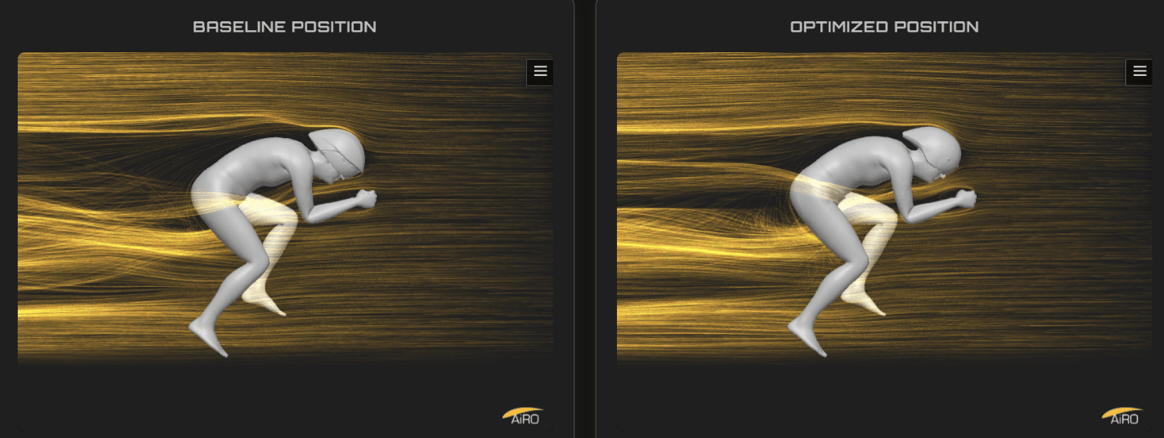
We can use AiRO to compare aero helmets too. We changed this riders’ helmet from the Giro Advantage to the Kask Mistral and saved him 2 watts. I like how much less black low pressure zone we see behind his head and back in the right photo. While this is easy to do in AiRO, it is definitely among the changes I would want to confirm in the real world too, as this rider isn’t pedaling, his head isn’t moving slightly side to side, and a number of other subtle differences that can impact which helmet is best in real life.
Watts Saved: 30
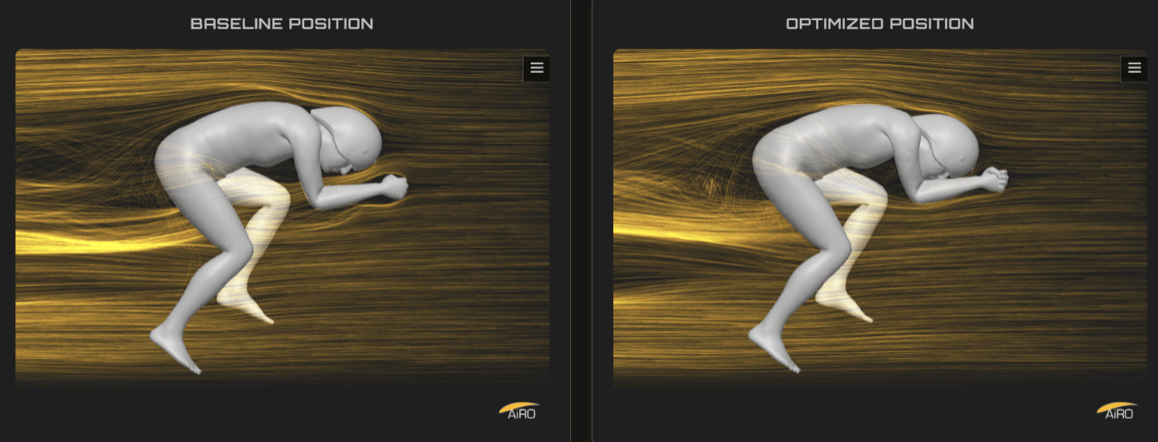
Are we really including this? As cool as this looks there are many reasons I hesitated to include these as it can give the wrong impression of who we typically work with. The vast majority of you are age group triathletes and recreational cyclists – and you are the reason Fit Werx is here – but let’s set that aside and be impressed for a moment. This young time trialist is already very fast and according to AiRO he is going to be much faster. He has the lowest AiRO CdA we’ve measured, but who’s counting… I had the same questions you do. First off, how can he even see? Can he hold that position for a full time trial and still generate power? The answer to all those questions is yes, believe it or not. We made step by step changes to his elbow width, extension angle, aerobar height, and where he held his head. We were curious what changes would be needed to completely close things off between his arms and helmet and whether it would be beneficial. It was surprising which changes worked and which didn’t matter. There’s a visor on the helmet that turned solid in AiRO, so he can look up the road through his hands more easily than you’d think at first glance. I most of all find the flow changes around his body amazing to look at. All that darker area behind him on the left is the lower pressure drag zone. Look how much smaller that low pressure zone is on the right. Most riders have lower pressure zones just above their backs, but we seemingly removed that zone entirely. CdA change in AiRO was 0.020 which is 20 watts in all the other examples, but for riders over 30mph this starts getting closer to 30 watts. We can’t wait to see how fast he goes this season, but for the rest of us it’s fun to wonder.
A proper bike fitting with an experienced fitter is as important as ever, but AiRO gives us a powerful tool to find further gains once fit is established. We recommend AiRO as a polishing tool that can be used both during and after your bike fitting. Our goal is always to find a comfortable, powerful, and sustainable aerodynamic position that helps you achieve your riding goals. A fast position does not need to compromise any of these principles. If you are interested in a session with AiRO, please contact Fit Werx Danvers today.
