
What is AiRO?
AiRO is a program that performs CFD (Computational Fluid Dynamics) to measure the aerodynamic impact of changes you make to a rider’s position. Definitions of CFD can be quite lengthy and detailed. Basically, it is a model that analyzes and predicts fluid flow around an object. This is very similar to what a wind tunnel does with air flow. I’ve been familiar with CFD for years, but never had access to using it, as only the big manufacturers had the resources to utilize such a complex program that required enormous computing power and time to run simulations. AiRO has harnessed the power of streaming and the cloud to allow for relatively quick data transfer so that remote analysis can be done by their servers from most anywhere with a reasonably fast internet connection.
AiRO can accurately calculate your CdA (Aerodynamic drag coefficient) by taking a digital scan of your position. If I didn’t lose you in that opening paragraph, then that should get your attention. Before having access to CFD, the only ways to measure your CdA were wind tunnel testing, velodrome testing, or field testing using virtual elevation or aero sensors with a power meter. Like the rest of these aero testing options, AiRO has its benefits but also has its limitations.

Using AiRO to Calculate CdA
How does it work? I opted to use a rider I know well to initially test AiRO out – me. It was easy to pull up a write-up from my own position in 2023: Power, Aero, & Comfort: Choose Three. – Rider First Bike Fitting. Rider Matched Bike Sales.
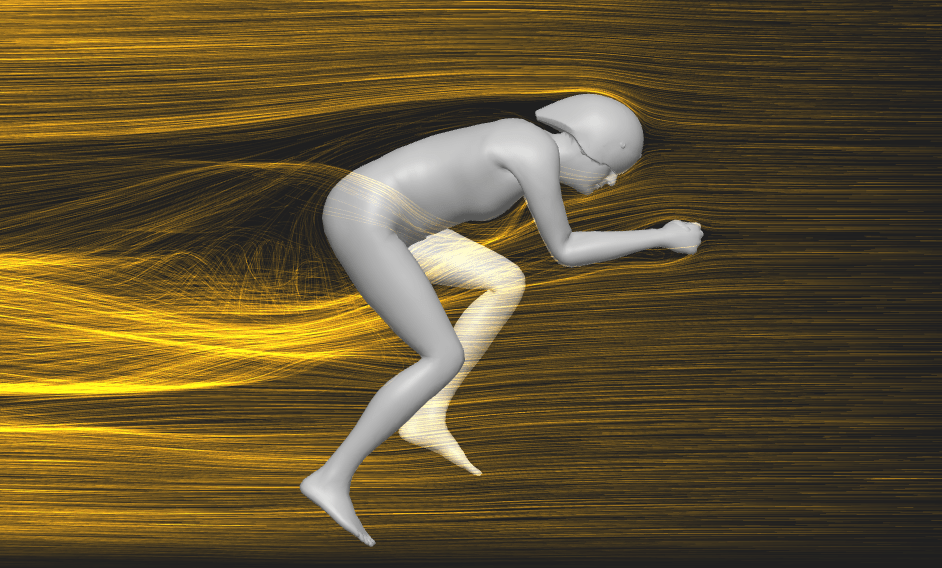
I also had Stephen’s clean photos of me from the side and front, which made for easy uploads. The digital twin that AiRO produced of me is below. I was surprised how close AiRO’s CdA value was to what I field tested, since many assumptions are built into it. While AiRO assumes some boundary layer conditions between your body and the air, it doesn’t know if you’ve shaved your legs, are wearing a cutting-edge skinsuit, or a wrinkled jersey. We can all get past that part and anxiously wait to see what changes are possible, all else being equal.

In addition to your digital twin’s CdA value, you can see a 3D illustration of where air is flowing below. Seeing changes in airflow is always interesting.
Using AiRO to Test Changes in Position
I spent the last two years aero testing far too many things to list. Since the write-up in the link, I’ve field tested 21 different days across two summers, all in the relentless pursuit of “free speed”. The majority of those tests were of changes that didn’t help or resulted in more drag – after twenty years of aero testing, I’m working pretty deep in the margins at this point. Over 100 position tests were done. I eventually honed in on a couple changes that when done at the same time as each other improved my CdA. It involved an extra 10 degrees of extension tilt while also narrowing my elbows. This change only helped when the aerobars were at a particular height; higher or lower and the improvement evaporated. I would also lose power if my elbows were too close, as the narrow width squeezed my chest just enough to compromise power. Also, the reach had to be perfect to do all three things at once. So, while this was my fastest position I’ve found to date, and the one that I ran at my last hour record attempt, there are a lot of variables required.
Knowing the complexity of these gains, I used the changes to see if AiRO could discern this much detail. I ran through many extension angles, pad widths, reach, and front-end height changes in AiRO. I came up with the following fastest position. To my amazement, the position AiRO led me to was where I had ended up – 10 degrees more arm tilt and narrower elbow pads. The CdA improvement of 0.015 reduction is slightly more than what I tested in the field, but the magnitude is close. I was impressed. I found the same improvements in one afternoon using AiRO that I’d spent 21 days over two summers aero testing for.
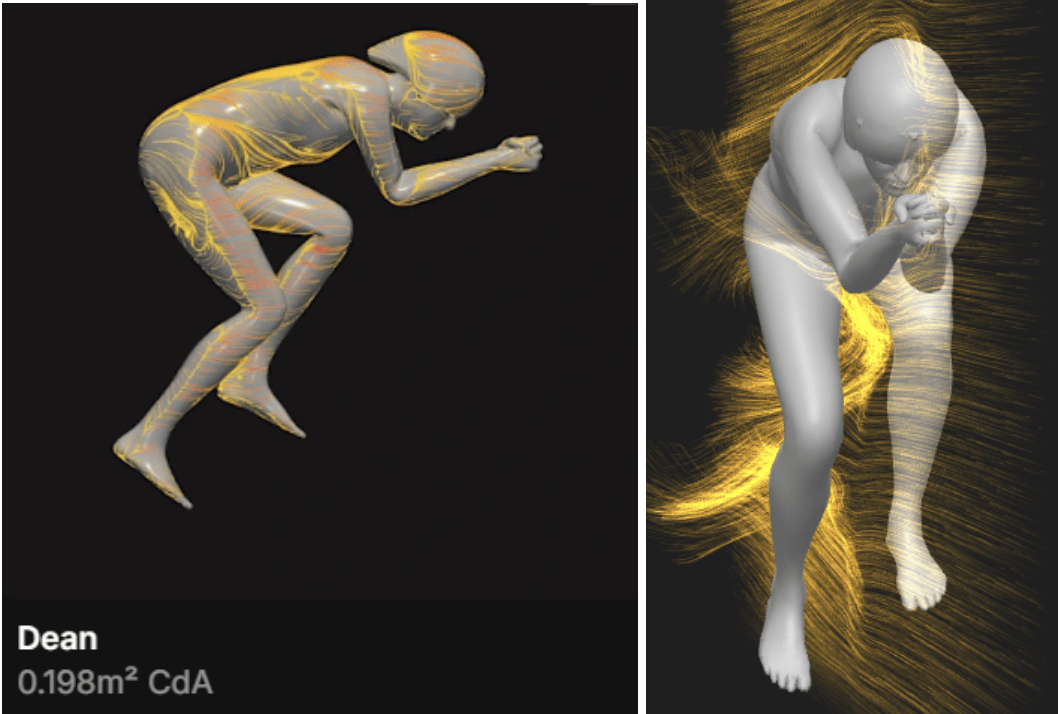
You can see how much narrower my elbows are in the flow view to the right.
Testing More Aggressive Positions with AiRO
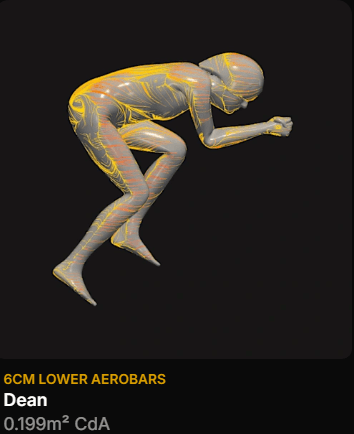
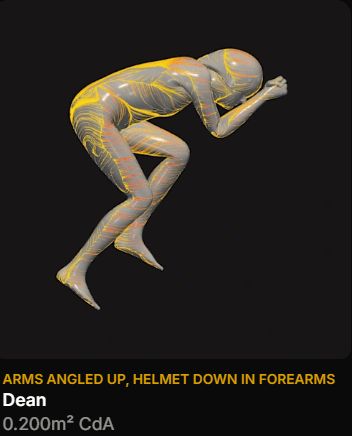
Having the analysis power of AiRO at hand, I started testing more aggressive positions, such as 6cm more aerobar drop and raising my aerobars and angling them in such a way that I could hide my face in my forearms, like you see some pros do. It was unlikely I’d be able to ride in either of these positions for comfort reasons, but the curiosity and ease of looking was too much. It was a relief to see AiRO didn’t find either of these scenarios any faster. Lower is not always faster! It was great being able to test this in a matter of minutes digitally, as changing aerobars on modern bikes these days can be a multi-hour project on its own. This is why knowing your riding position before you get your next new bike, and having that bike built to match it, offers more value than ever.
Using AiRO with Client Athletes
Kevin is a rider who we have set-up on a number of different triathlon bikes over the years. I have worked with him for a long-time to continue to nurse more speed and comfort out of his distance triathlon position. As a long-course triathlete, Kevin needs to be comfortable, powerful, and aerodynamic to enjoy top performance in all his training and racing. We ran through the steps to make Kevin’s digital twin below:

AiRO concluded Kevin’s CdA is 0.235. For a 6’2” triathlete, this is a decent start, but Kevin is most interested in possible gains.
Based on my experience where gains are most likely to be made, we tested a range of changes on Kevin’s digital twin. We angled extensions up 5, 10, 15 degrees from where they are right now. We also narrowed his elbow pads by 8 cm to a very narrow setting. We were both a bit surprised that none of these changes improved Kevin’s CdA. We tried several aero helmets pre-loaded in the AiRO program, and none of them tested faster than his current Rudy Wing helmet. This, of course, was a good time to insert the “Your prior Fit Werx fitting already positioned you in your ideal position“ comment. We laughed and kept looking for improvement.
We started trying some things we were unsure Kevin would be able to maintain, just to see. Stretching Kevin out a significant 5cm reduced drag down to 0.231 as shown below:
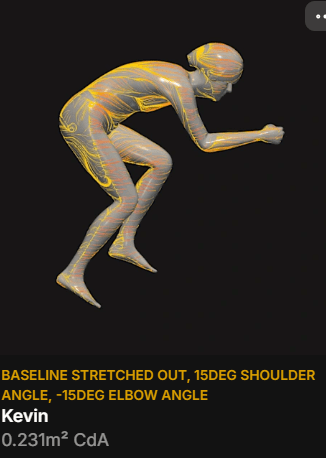
The trouble with this position is it revisited something we’d tried years ago, and he was not comfortable. This change would certainly result in him not being able to hold the position, and aerodynamics for long-course triathlon is nothing without sustainability. Lastly, we moved the focus to technique items that Kevin might be able to make gains from.
Testing Rider Posture with AiRO
It was time to focus on how Kevin holds himself on the bike. We adjusted the model’s back curvature and rotated its shoulders so its torso flattened. A flatter back is sometimes faster, but not always, as many variables impact drag. Through a couple of simulations, we found a body shape that significantly reduced Kevin’s CdA shown below.

This is where it’s easy for bike-fitting reality to clash with the perfect world of straightforward CFD results. We knew that these positioning changes would not work for Kevin from a comfort and sustainability perspective. Rotating his hips and back to match up to his “digital twin” resulted in pain and power loss. Kevin felt like he couldn’t even get his foot over the top of the pedal stroke. While his digital twin was OK with the change, real Kevin’s body wasn’t having it.
Just like in the wind tunnel, simply lowering somebody or stretching them out in AiRO can result in a lower CdA. However, it’s pretty easy to position somebody in a position that is impossible to sustain with AiRO’s analysis, too. This said, we did learn a number of lessons, and Kevin now has a roadmap he can be confident in to help him continue to chase free watts by pursuing body posture details that will make him faster.
AiRO Best Practices
AiRO is a powerful fitting analysis and validation tool. It does not change the approach we have always taken at Fit Werx where fundamental fitting principles are not ignored. Our goal is always to find a comfortable, powerful, and sustainable aerodynamic position that helps you achieve your riding goals. A fast position does not need to compromise any of these principles. We recommend AiRO as a polishing tool that can be used both during and after your bike fitting. With the AiRO program at Fit Werx, any triathlete or cyclist who has been interested in a wind tunnel session, can now access it at a much lower cost and with a much lower time investment. If you are interested in a session with AiRO, please contact Fit Werx – Peabody today.
